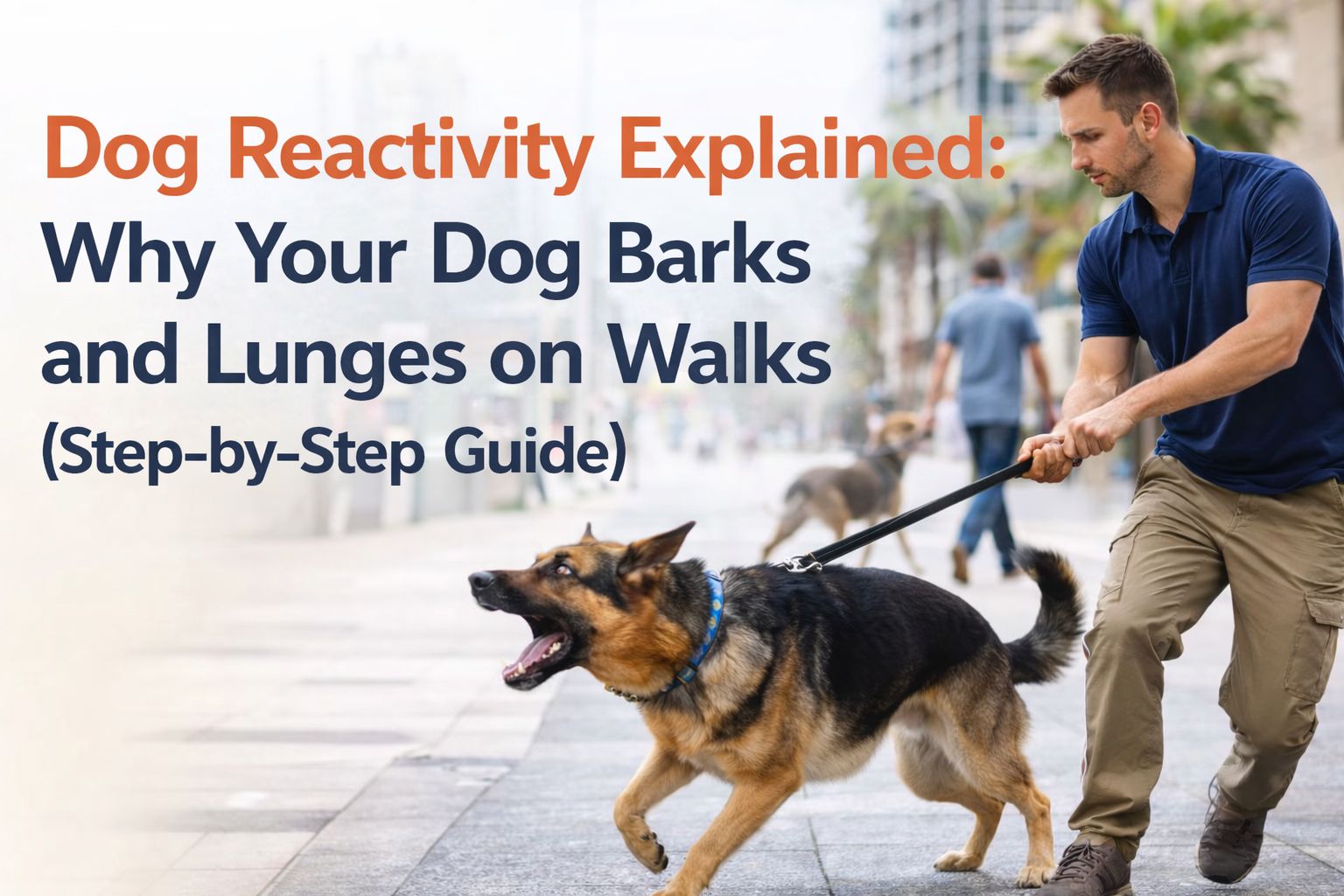
Dog Reactivity Explained: Why Your Dog Barks and Lunges on Walks
If your dog barks, lunges, or loses control on walks when seeing other dogs or people you are not dealing with aggression.You are dealing with reactivity. Dog reactivity is one of the most common...
If your dog barks, lunges, or loses control on walks when seeing other dogs or people you are not dealing with aggression.
You are dealing with reactivity.
Dog reactivity is one of the most common behavioural problems we see in Dubai and across the UAE, especially in busy environments where dogs are constantly exposed to triggers.
And the biggest mistake owners make is trying to “correct” the behaviour without understanding it.
This guide explains what reactivity really is, why it happens, and how to start fixing it properly.
What Dog Reactivity Actually Is
Reactivity is an emotional response, not disobedience.
It happens when a dog:
- Becomes overwhelmed
- Cannot regulate excitement or stress
- Reacts instead of thinking
This often shows as:
- Barking
- Lunging
- Fixating
- Pulling toward or away from triggers
👉 Important:
Reactivity is not the same as aggression.
Many reactive dogs are not aggressive; they are simply overstimulated or frustrated.
Why Dogs Become Reactive
Reactivity does not appear randomly. It develops over time.
1. Overexcitement
Dogs that cannot control excitement often escalate into reactive behaviour.
👉 If your dog is already jumping or overly excited, read:
how to calm an overexcited dog
2. Frustration
Dogs that are not allowed to reach what they want (dogs, people) build frustration.
This often comes from leash pulling.
👉 Related:
dog pulling on leash: how to stop it
3. Lack of Proper Socialization
Uncontrolled or limited exposure leads to poor coping skills.
👉 Learn more:
puppy socialization in Dubai
4. Fear or Insecurity
Some dogs react because they are unsure or uncomfortable.
This often looks similar to aggression but has a different root cause.
Signs of a Reactive Dog
- Barking at other dogs or people
- Lunging on the leash
- Fixating and not responding
- Pulling strongly toward triggers
- Ignoring commands in stimulating environments
At this point, your dog is not choosing behaviour it is reacting emotionally.
Why Reactivity Gets Worse Over Time
Reactivity is self-reinforcing.
Every time your dog reacts:
- It releases tension
- It repeats the behaviour
- It becomes more automatic
Without intervention, it often escalates into:
- Strong leash pulling
- Overexcitement
- Loss of control in public
👉 If your dog also jumps on people, read:
how to stop your dog from jumping on people
Common Mistakes Owners Make
These mistakes make reactivity worse:
- Forcing the dog to “face the trigger”
- Allowing greetings when the dog is excited
- Pulling the leash aggressively
- Trying to use commands when the dog is overwhelmed
- Avoiding everything completely (no exposure at all)
Reactivity is not solved by force or avoidance alone.
It requires structure.
Step-by-Step: How to Start Fixing Reactivity
This is where real training begins.
Step 1: Create Distance
Distance is your best tool.
If your dog reacts:
👉 you are too close
Create space until your dog can stay calm.
Step 2: Work Below Threshold
Your dog must be able to:
- Look at the trigger
- Stay calm
- Respond to you
If not, learning is not happening.
Step 3: Reward Calm Behaviour
Do not wait for perfect behaviour.
Reward:
- Looking without reacting
- Calm posture
- Disengaging from the trigger
This teaches:
👉 calm = success
Step 4: Build Focus on You
Your dog must learn that you are more important than the environment.
Start in low-distraction environments and build gradually.
Step 5: Control Exposure
Do not allow uncontrolled interactions.
Structure:
- When your dog sees triggers
- How close you get
- When interaction happens
Random exposure creates inconsistent results.
Real-Life Situations
Dog Barks at Other Dogs on Walks
- Increase distance
- Do not allow greeting
- Reward calm observation
Dog Lunges at People
- Reduce exposure
- Control leash
- Reinforce calm behaviour
Dog Is Fine at Home but Reactive Outside
This is common in Dubai environments.
👉 The issue is overstimulation, not obedience.
When You Need Professional Help
You should consider structured training if:
- Your dog reacts strongly on every walk
- You feel you cannot control your dog
- Behaviour is getting worse
- Barking turns into lunging or aggression
Reactive dogs require controlled environments and proper guidance.
Why Structured Training Works
Reactivity is not fixed with simple tips.
It requires:
- Controlled exposure
- Timing
- Consistency
- Behaviour understanding
This is where professional training makes a major difference.
Final Thoughts
Reactivity is not about a “bad dog”.
It is about a dog that has not learned how to cope with the environment.
With the right structure, dogs can learn:
- To stay calm
- To focus
- To disengage
The earlier you address it, the easier it is to fix.
FAQ: Dog Reactivity
Is my dog aggressive or reactive?
Most dogs are reactive, not aggressive. Proper assessment is important.
Can reactivity be fixed?
Yes, but it requires structured training and consistency.
Should I avoid all triggers?
No. Avoiding everything prevents learning. Controlled exposure is key.
How long does it take to fix reactivity?
It depends on severity, but progress starts with the correct structure.
Need Help With Your Dog?
If your dog barks, lunges, or loses control on walks, structured behaviour training can help you regain control and build calm, reliable behaviour.
We work with reactive dogs across Dubai and Abu Dhabi, focusing on real-world situations and long-term results.
You Might Also Like
Why Your Dog Is Not Listening Even After Training
Your dog still doesn’t listen after training? Discover the real reasons why dog...
Read more
Is Dog Daycare Good or Bad? The Truth Most Owners Don’t Know
Is dog daycare good or bad? Discover the real pros and cons of dog daycare, and...
Read more
Dog Pulling on Leash: How to Stop Leash Pulling in Dogs (Step-by-Step)
If your dog pulls on the leash during walks, you’re not dealing with stubbornnes...
Read more
Dog Overexcited When Greeting People: How to Calm an Overstimulated Dog
If your dog becomes uncontrollable when people come over, jumps excessively, bar...
Read more